
PMK 28/2026 Signals Higher Transfer Pricing Stakes
Read Now ->

Minister of Finance Regulation Number 111 of 2025 (MoFR 111/2025, also referred to as PMK 111 Tahun 2025) on Taxpayer Compliance Supervision takes effect on January 1, 2026. It sets out how the Directorate General of Taxes (DGT) supervises registered taxpayers, unregistered taxpayers, and economic activity in each working area, including through the Request for Explanation of Data and/or Information (SP2DK).
summary:
| Regulation | MoFR 111/2025 (PMK 111/2025) concerning Taxpayer Compliance Supervision |
|---|---|
| Effective date | January 1, 2026 |
| Scope of supervision | Registered Taxpayers, Unregistered Taxpayers, Regional Supervision |
| Supervisory activities for registered taxpayers | SP2DK, Tax Compliance Reminder Letter, Warning Letter |
| SP2DK response deadline | 14 days, extendable by 7 days |
| 2026 tax revenue target | IDR 2,693 trillion, around 23% above the 2025 realization |
| Supporting system | DGT Coretax |
The year 2026 marks a new era of increasingly aggressive and integrated data-based tax supervision. With the tax revenue target of IDR 2,693 trillion, an increase of around 23% compared to the 2025 realization. Therefore, the Directorate General of Taxes (DGT) is required to carry out more intensive supervision efforts to optimize state revenue.
In this context, the two main instruments that will be the focus of implementation in 2026 are the launch of the DGT Coretax system and the enactment of Minister of Finance Regulation Number 111 of 2025 concerning Taxpayer Compliance Supervision, which effective starting on January 1, 2026. These two policies strengthen the data-based supervision approach, digitize processes, and improve the effectiveness of taxpayer compliance monitoring.
| No. | Scope of Supervision | Forms of supervision in the fulfillment of tax obligations | Forms of Supervisory Activities | Taxpayer Obligations |
|---|---|---|---|---|
| 1 | Registered Taxpayers |
|
Main activities: Supporting activities: |
For the purposes of DGT supervision, taxpayers must respond to requests for explanations of data and/or information and/or the delivery of tax compliance reminder within a specified period of time, attend invitations from the DGT to appear at the DGT office either offline or online, and provide the DGT with the opportunity to conduct visits. |
| 2 | Unregistered Taxpayers |
|
||
| 3 | Regional Supervision | supervision of economic activities carried out by taxpayers and identification of taxpayers in each working area. |
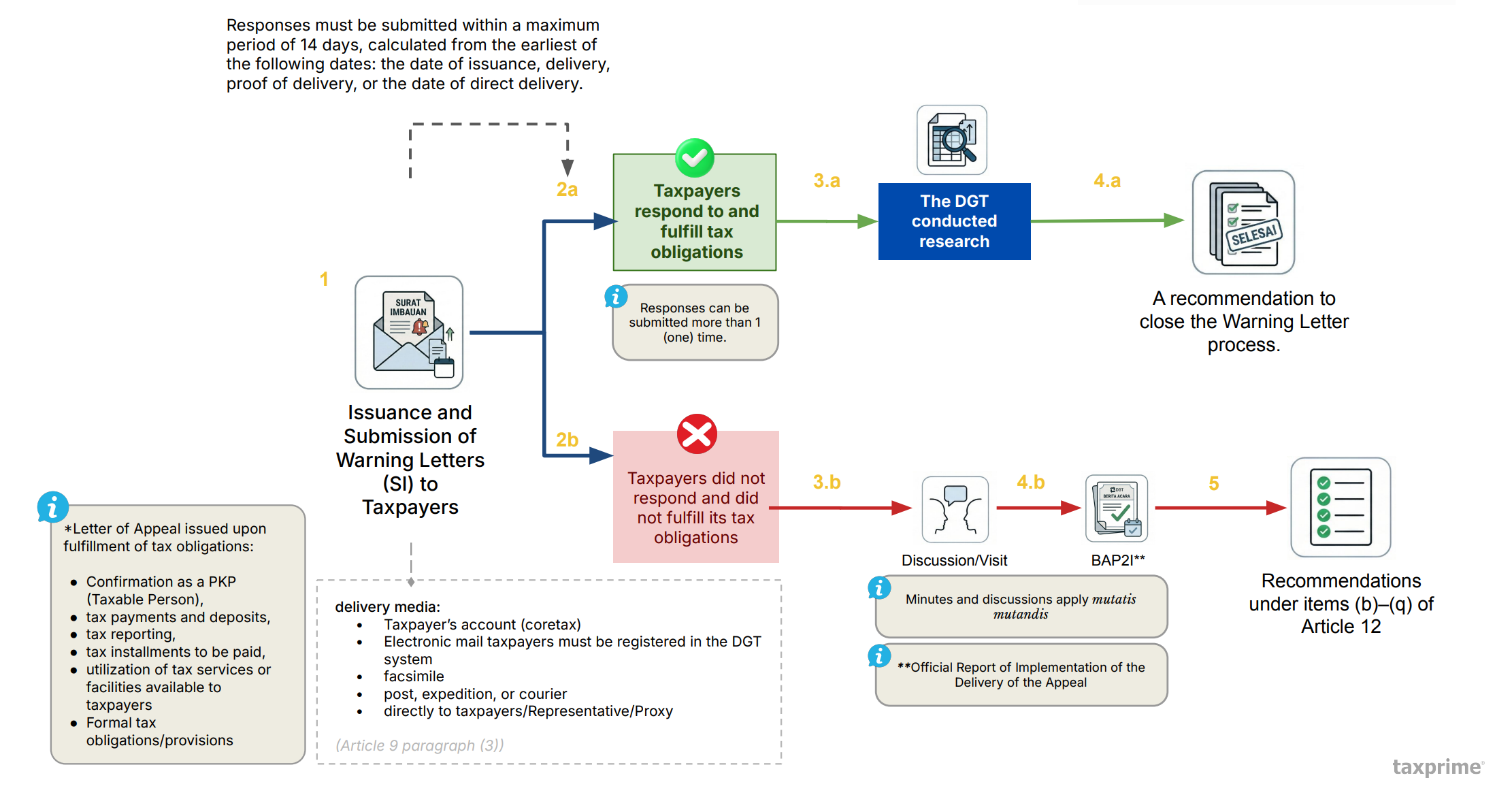
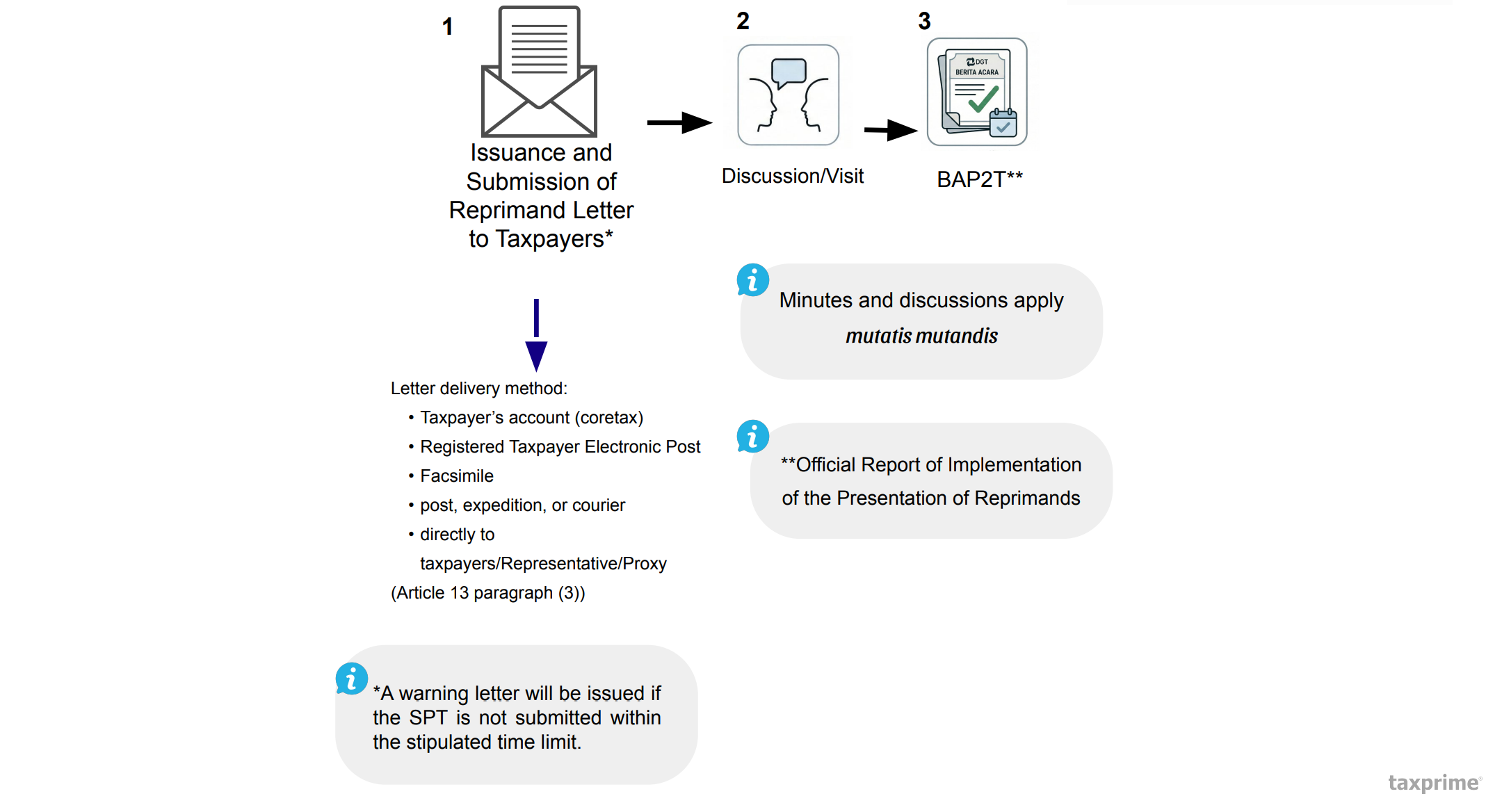
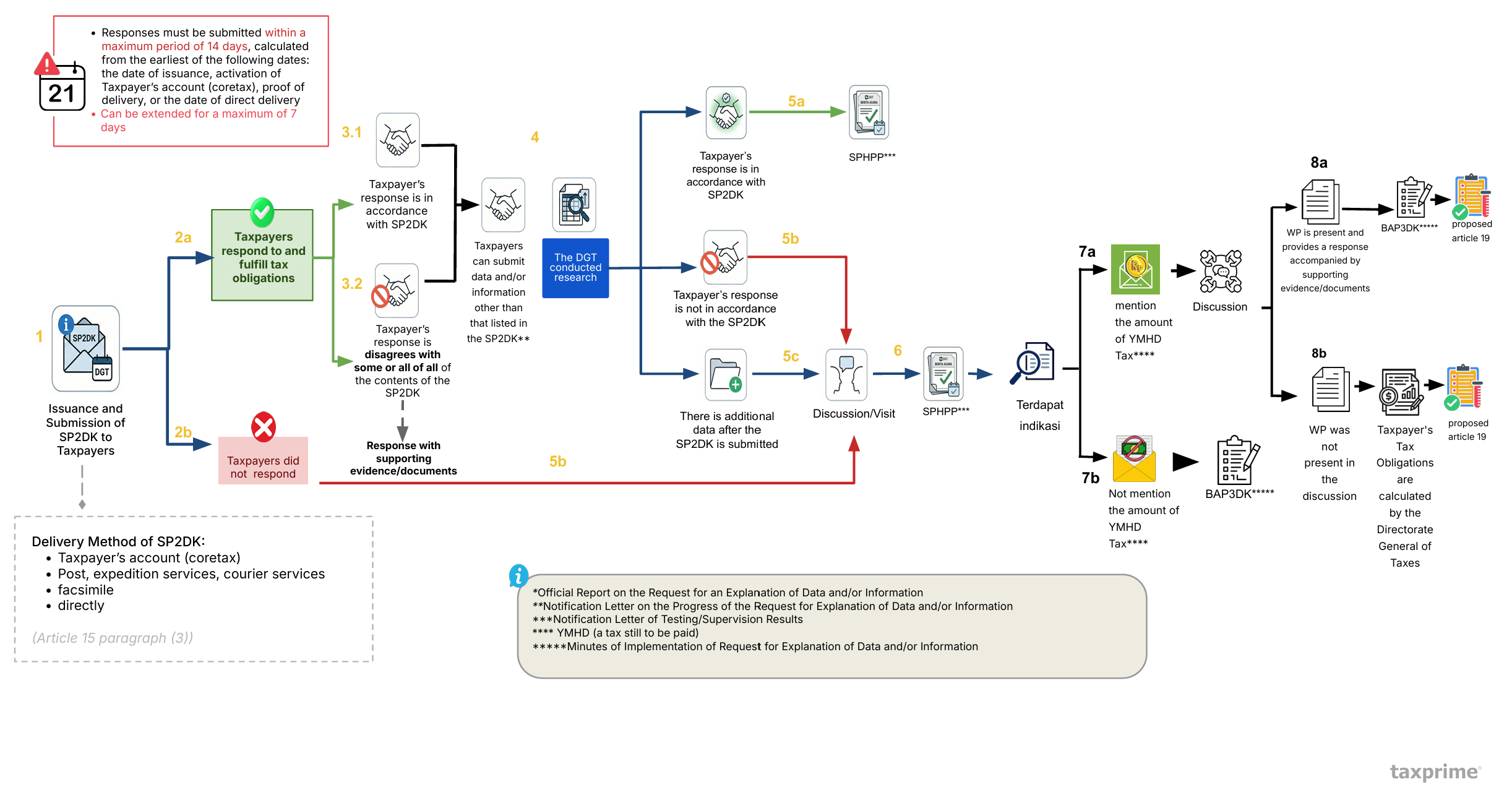
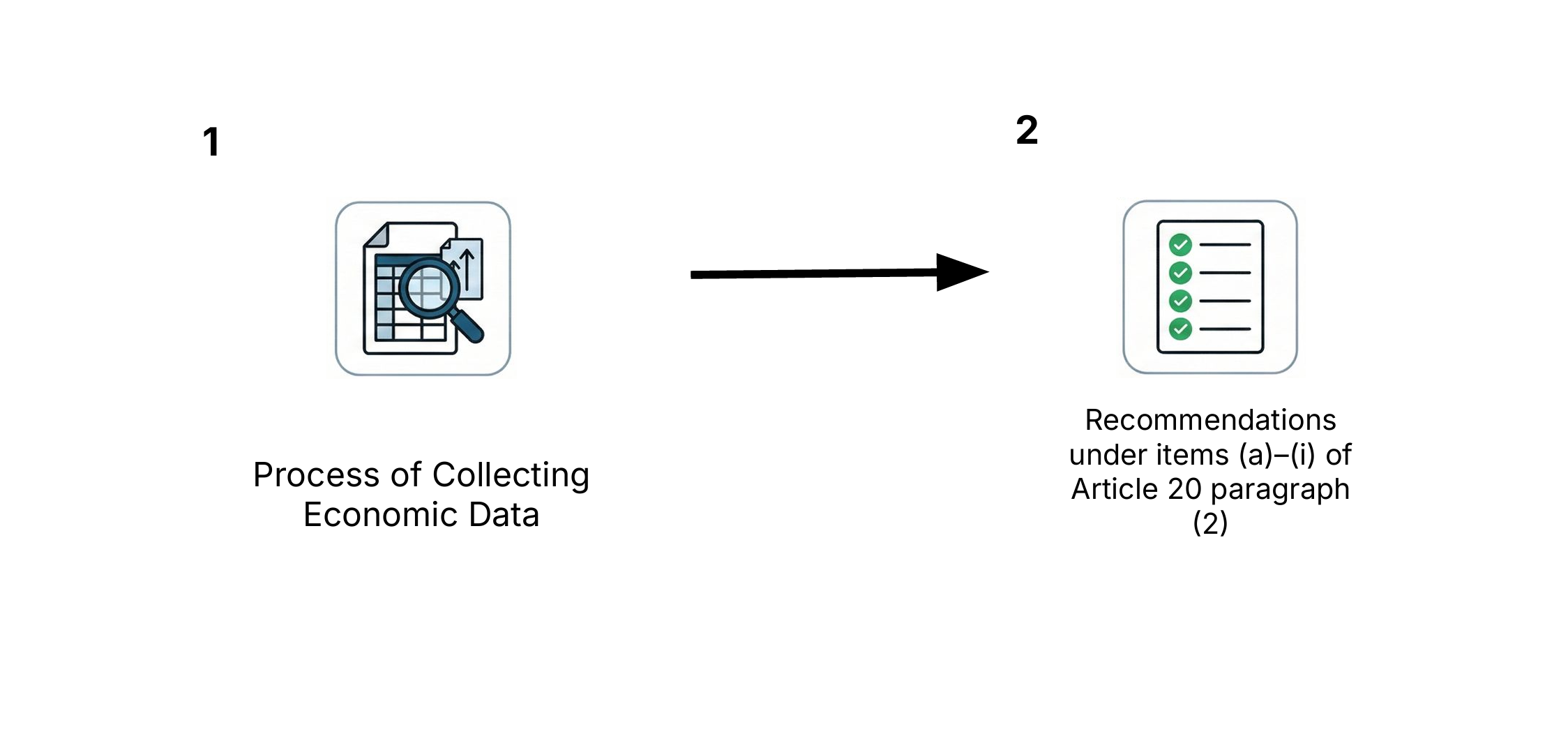
To facilitate understanding, the procedures for implementing supervision are presented in the following flowchart:
In order to supervise registered taxpayers, the DGT may carry out three types of supervisory activities, namely through the issuance of a Request for Explanation and/or Information Letter (SP2DK) (Appendix 1a), a Reminder Letter (Appendix 1b), and a Warning Letter (Appendix 1c). The procedures for conducting each of these monitoring activities are provided in the attachments to this newsletter (download here).
The procedures for implementing supervision of unregistered taxpayers are provided in Appendix 2.
The procedures for implementing supervision of regional supervision are provided in Appendix 3).
The increase in the 2026 tax revenue target, which is approximately 23% higher than the realization in the previous year, indicates a significant challenge for the DGT. This condition encourages the DGT to work more intensively in optimizing state revenue, among others through strengthening taxpayer compliance supervision and utilizing a more integrated tax administration system such as Coretax. These efforts are expected to improve taxpayer compliance while supporting the achievement of the tax revenue target.
Optimizing state revenue is supported not only by system transformation through Coretax, but also by the strengthening of supervisory mechanisms regulated under MoFR 111/2025. This provision reflects a broader and more integrated approach to supervision, covering registered taxpayers, potential unregistered taxpayers, as well as regional-based supervision to capture economic potential that has not yet been fully reported in the tax system.
Taxpayers who receive a Request for Explanation of Data and/or Information (SP2DK) must respond within 14 days of the letter being delivered, either by post, taxpayer account, or in person, depending on which event occurs first. If necessary, taxpayers may request a 7-day extension. During this process, maintaining a cooperative and transparent approach with the DGT is important to ensure that the clarification process runs smoothly and to minimize potential differences in interpretation. Therefore, taxpayers are encouraged to implement audit-ready management by preparing relevant data, documentation, and reconciliations from the beginning of the bookkeeping process, rather than only when the SP2DK is received.
Audit ready management is an important approach for taxpayers to face increasingly intensive tax audits. Through this approach, companies proactively prepare data and documentation from the bookkeeping process to tax reporting, including inventorying and equalizing items that may be of concern to tax authorities.
With data readiness maintained from the outset, taxpayers can respond to requests for clarification, such as the Request for Explanation of Data and/or Information (SP2DK), more quickly and in a structured manner. This preventive approach not only helps meet response deadlines, but also minimizes the risk of errors, strengthens transparency, and creates more constructive communication between taxpayers and tax authorities.
MoFR 111/2025 is Minister of Finance Regulation Number 111 of 2025 concerning Taxpayer Compliance Supervision. Together with the DGT Coretax system, it strengthens the data-based supervision approach, digitizes processes, and improves the effectiveness of taxpayer compliance monitoring.
MoFR 111/2025 is effective starting on January 1, 2026.
Supervision covers three scopes: Registered Taxpayers, Unregistered Taxpayers, and Regional Supervision of economic activities carried out by taxpayers in each working area.
SP2DK is the Request for Explanation of Data and/or Information Letter. It is one of three supervisory activities the DGT may use for registered taxpayers, alongside the Reminder Letter and the Warning Letter.
Taxpayers must respond within 14 days of the letter being delivered, either by post, taxpayer account, or in person, depending on which event occurs first. If necessary, taxpayers may request a 7-day extension.
Taxpayers must respond to requests for explanations of data and/or information and/or the delivery of tax compliance reminder within a specified period of time, attend invitations from the DGT to appear at the DGT office either offline or online, and provide the DGT with the opportunity to conduct visits.
Audit-ready management is an approach in which companies proactively prepare data and documentation from the bookkeeping process to tax reporting, including inventorying and equalizing items that may be of concern to tax authorities. It helps taxpayers respond to an SP2DK more quickly and in a structured manner.
The 2026 tax revenue target is IDR 2,693 trillion, around 23% higher than the 2025 realization. This encourages the DGT to strengthen taxpayer compliance supervision and use a more integrated tax administration system such as Coretax.